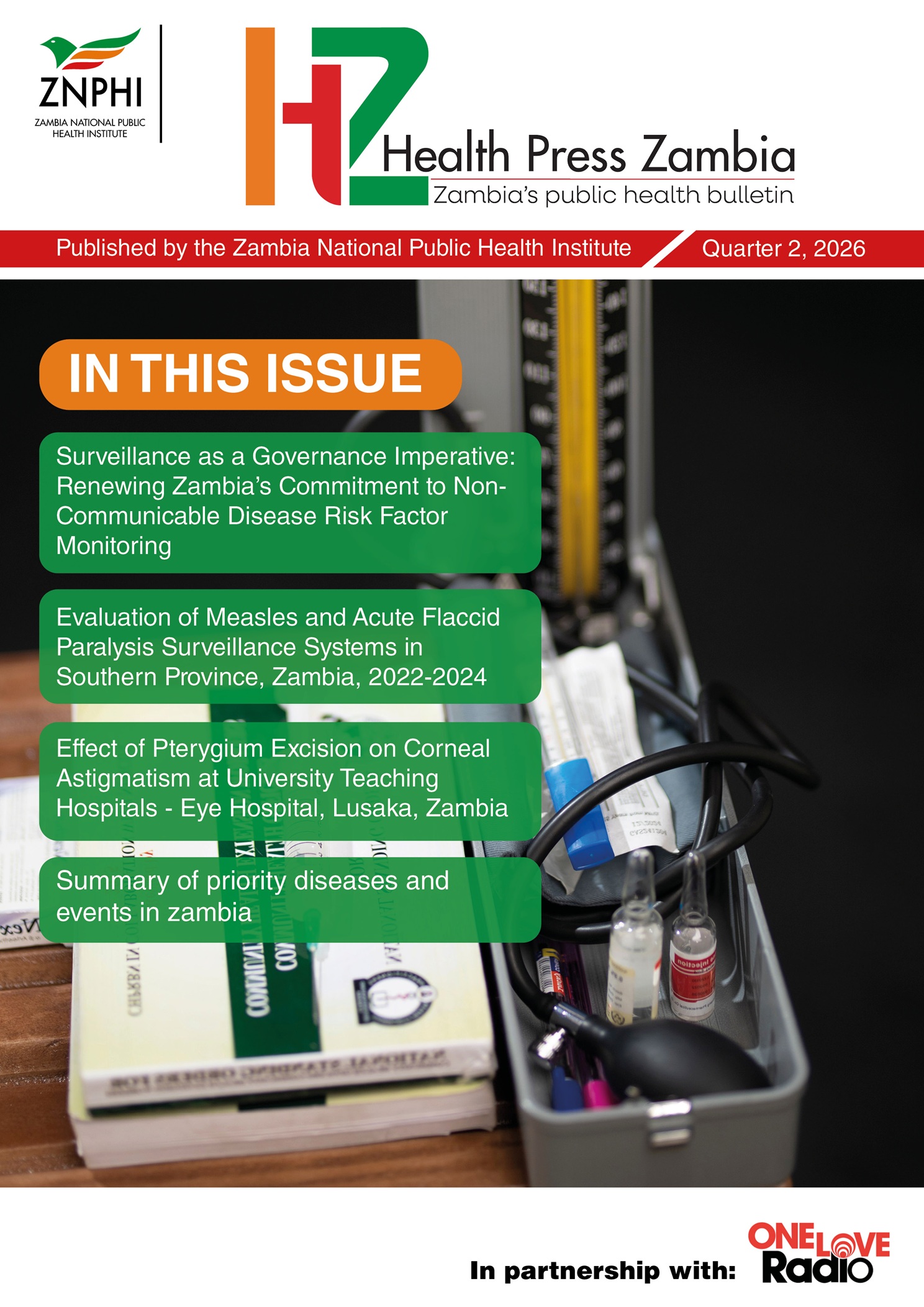
Featured in this issue is an editorial advocating for application of a Social Ecological Model framework to guide cholera response efforts. This approach unpacks multiple, interconnected drivers of transmission, from individual behaviours to community, institutional, and policy-level determinants. Complementing the editorial are outbreak investigations reports on recent cholera outbreaks in Central and Northern Provinces. Also featured is a study on Konzo disease in Luampa District, Western Province, which identifies key demographic, nutritional, and behavioural risk factors.
Cholera continues to pose a significant public health threat across Africa, driving outbreaks that result in avoidable illness and death. Globally, an estimated 2.8 million cases and 95,000 deaths occur annually [1], with Africa carrying the greatest burden: 82% of cases and 94% of deaths [2]. Between January and August 2025 alone, 213,586 cases and 4,507 deaths were recorded across 23 African Union (AU) Member States [3]. Projections for the upcoming rainy season (September 2025–February 2026) predict more than 200,000 additional cases and 6,020 deaths, representing a 42% increase in cases and nearly double the number of deaths compared to 2024, if current efforts remain unchanged [2].
In response to this growing crisis, the Africa Centre for Disease Control and Prevention (Africa CDC) and World Health Organization (WHO) launched a six-month continental cholera response plan on August 26, 2025, in Lusaka, Zambia. This initiative, endorsed by African Union (AU) Cholera Champion President Hakainde Hichilema, aims to accelerate progress toward eliminating cholera by 2030. The plan prioritizes seven key areas: coordination, surveillance, laboratory capacity, case management, WASH (water, sanitation, and hygiene) interventions, vaccination, and community engagement [2,3]. President Hichilema's leadership reflects strong political commitment essential for achieving a cholera-free Africa.
Zambia exemplifies the persistent challenge of cholera control. Almost every rainy season triggers new outbreaks, driven by inadequate WASH infrastructure, particularly in urban and peri-urban settlements [4]. The country has faced 29 outbreaks between 1977 and 2018, with case fatality rates ranging from 0.5% to 9.3% [4–6]. The 2023/24 outbreak alone recorded 23,381 cases and 740 deaths across nine provinces, with Lusaka, Central, and Eastern provinces most affected [5,6]. These outbreaks strain health services, disrupt livelihoods, and highlight deep-rooted structural and environmental drivers of cholera transmission.
To strengthen understanding and guide action, it is useful to interpret these outbreaks through the Social Ecological Model (SEM), which highlights how individual, community, institutional, and policy-level factors interact to perpetuate cholera transmission.
The Social Ecological Model (SEM), developed by psychologist Uriel Bronfenbrenner in the late 1970s, is a key framework in public health for understanding multiple and interconnected influences on health outcomes. It recognises that health behaviours and outcomes are not shaped by a single factor, but emerge from interactions across different levels of society [7,8].
At the individual level, health outcomes are influenced by knowledge, attitudes, behaviours, and biological factors. In contrast, the interpersonal level reflects the impact of family, peers, and social networks on health practices. The community level encompasses cultural norms, neighbourhood conditions, and access to local resources that support or hinder healthy behaviours [7,8]. At the institutional level, the effectiveness of service delivery systems, schools, workplaces, and health facilities plays a vital role, and at the policy or structural level, governance, legislation, public health regulations, and resource allocation determine the broader systems and infrastructure that sustain population health [7,8].
Applying the SEM to diseases such as cholera can help identify both immediate and structural drivers of transmission, enabling policymakers and practitioners to design more comprehensive and sustainable interventions beyond individual behaviour change.
Cholera transmission in Zambia is shaped by multiple, interconnected factors across different levels of the SEM. At the individual level, misconceptions about transmission and prevention persist despite general awareness, contributing to poor uptake of WASH practices and delayed treatment [6,9]. Interpersonal influences, particularly within overcrowded households in Lusaka, which account for nearly 75% of cases, compound risks through inadequate sanitation, contaminated water, and stigma that discourages early care-seeking [6].
At the community level, cultural practices, misinformation, reliance on unsafe water sources, and limited access to sanitation exacerbate outbreaks [6,10]. Only 68% of households in Zambia have access to improved water sources, and just 40% have access to improved sanitation, while rapid urbanisation, reliance on shallow wells in peri-urban areas, and seasonal flooding continue to heighten the risk of water contamination [5,10].
Organisational and institutional weaknesses, including inadequate surveillance, limited laboratory capacity, low emergency preparedness, and a critical shortage of health workers (11.2 per 10,000 in rural areas and 18.7 per 10,000 in urban areas, against the WHO standard of 40) [6], continue to undermine effective outbreak response. At the policy level, fiscal constraints, reduced WASH investment, weak enforcement of public health regulations, and weak inter-ministerial coordination undermine sustainable prevention efforts [6,10]. Collectively, these factors demonstrate that cholera in Zambia is not simply a matter of individual behaviour but a multi-level challenge rooted in social, environmental, institutional, and structural determinants.
The recurrence of cholera outbreaks in Zambia highlights persistent weaknesses in current response strategies. Guided by the SEM, elimination efforts must address determinants at multiple levels: from individual to policy. This will require (1) urgent, sustained, and multisectoral action focused on expanding oral cholera vaccination, (2) investing in long-term WASH solutions, (3) strengthening community health education, (4) building resilient health systems for rapid detection and response, (5) enforcing sanitation and housing regulations, and (6) fostering cross-sectoral partnerships to tackle the structural drivers of outbreaks.
The launch of the continental cholera response plan in Lusaka reflects strong political leadership and renewed momentum toward cholera elimination. For Zambia, this presents both an opportunity and a responsibility to act across all levels of the SEM: empowering individuals and communities, strengthening institutions, and reinforcing policy and structural systems for sustainable WASH improvements. Cholera elimination is achievable if coordinated action, political will, and community ownership align to end recurring outbreaks.
| Format | File Size | Download |
|---|---|---|
| ~2.5 MB | Download PDF | |
| HTML | ~1.2 MB | View HTML |
| Full Text | ~850 KB | Read Online |
| References | ~120 KB | Download References |